
Interview with KRIEG-B (1/2)
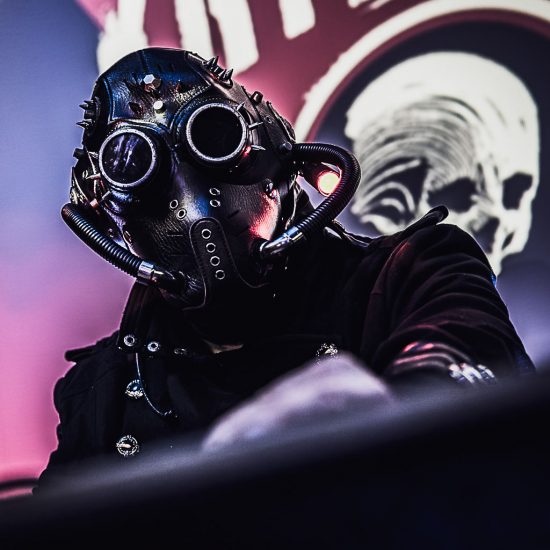
We talk to Krieg-B, which consists of Frenchman Dominique Lallement and Belgian Benoît Buyse, about their latest album “War Drums’ Resonance”. We explore the beginnings of the project, their influences, what the name is all about and also take a look into the future.
Orkus: Let’s start at the very beginning. How was Krieg-B founded?
Dominique Lallement: KRIEG-B came about quite naturally from our shared background in the dark electronic and industrial scene, but above all from our earlier music projects. I myself was involved in several projects, including Kriegbereit, K-Bereit and Cobalt 60, a project with Jean-Luc De Meyer from Front 242, which gave me valuable experience in EBM and industrial both in the studio and on stage. Benoît, for his part, was active through projects such as Dreadfool and Anamorphosis, which allowed him to explore darker, more experimental and aggressive soundscapes. This common but complementary background made the collaboration quite obvious. We already came from similar worlds and had a shared vision of music: something physical, intense, designed as much for the stage as for production. Krieg-B was built on this foundation, with the intention of bringing our experiences together to create something more direct, coherent and identifiable. We all share a strong fondness for EBM, industrial and dark electronic music, but also for its visual and emotional dimension.
O: The French and Belgians often have a kind of love-hate relationship. – Does that apply to you?
DL: You could say that this is more of a funny cliché for us than any kind of reality. In our case, there is absolutely no “love-hate” relationship between the French and the Belgians. The only real debates we sometimes have are about far more important things… like the best beer or the best fries. (laughs) But this is of course a very serious matter… at least in theory! (winks) With Krieg-B, it’s actually the other way around: what matters to us is what connects us, not what divides us. We come from scenes that have always been very close, especially in EBM and industrial music, where borders don’t really matter. Of course there are cultural differences and sometimes slightly different ways of working, but that’s what makes the exchange interesting and creative. Ultimately, it enriches the project rather than complicating it. So no, there’s no cold war here – just a natural, complementary collaboration… and occasionally some very serious discussions about beer. (winks)
O: To what extent do you bring the best of both worlds into your sound?
DL: We come from different but complementary backgrounds, and that’s where our strength lies. On the one hand, there’s a very strong foundation rooted in classic EBM and industrial music, with a particular focus on rhythmic efficiency, tension and the power of sequencing. On the other hand, there is a more modern sensibility that is more open to textures, sound design and evolving structures. For us, the “best of both worlds” is this mixture of a direct, almost raw and mechanical foundation and an atmospheric, more emotional level. We don’t try to choose between old-school and modernity, but to let both coexist. Our previous experience in various projects also plays a key role: it allows us to get straight to the point, to understand what works on stage and to maintain a certain discipline in the creation of the tracks. Ultimately, Krieg-B moves between these two poles: industrial rigor and a more contemporary approach to sound. It’s this tension that defines our identity.
O: How did you come up with the band name Krieg-B?
DL: The name Krieg-B fits seamlessly into the continuity of my musical journey. It’s not a concept conceived in a boardroom, but a natural evolution after Kriegbereit, my first industrial project, and then K-Bereit following Cobalt 60. Krieg-B is simply the next step on this path. I also suggested the name to Benoît and he immediately agreed, as it fitted perfectly with the spirit we wanted for the project. There is also a clear link to a certain vision of the industrial scene, particularly that of Front 242. We identify with this idea of a band as a direct unit, almost military in its stage presence. The image of the “musical commando” mentioned by Patrick Codenys fits very well with the way we work: We come, we play, we deliver the energy and then we disappear again. Krieg-B works in this sense: something frontal, without detours, focused on impact and energy. The name also simply reflects the current times, which are characterized by tensions and a kind of permanent chaos. It’s not a theoretical statement, but a global feeling that fits naturally with the music.
In the next part, we will talk in more detail about the debut album “War Drums’ Resonance”.
Claudia Zinn-Zinnenburg
Watch the video for “Get Out”:
Schon unseren Newsletter abonniert?
Hier kannst Du das gedruckte Orkus!-Magazin abonnieren:


