
An Interview with THE HARDKISS (Part 2 of 2)
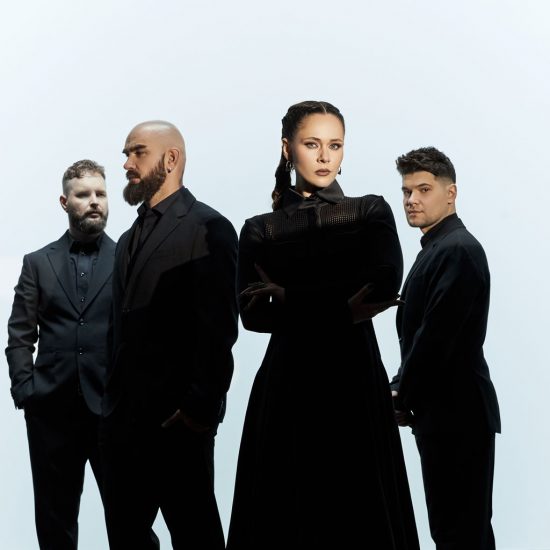
In our two-part interview, we talk with Julia Sanina of The Hardkiss about the new album “Grey Hound,” cold concrete, the concept of “time,” and the changes she’s witnessed over the band’s 15-year history. Did you miss the first part? No problem, you can read it here.
O: Which song on “Grey Hound” means the most to you personally, and why?
Julia Sanina: I think every band member would answer this question differently, but for me, it’s “Opera.” It’s a very expansive composition, both musically and emotionally. As a singer, the song gives me a lot of room to express myself, and the lyrics are also very emotional.
Interestingly, the lyrics came to me very quickly. For me, that’s usually a good sign. I love those moments when a song almost writes itself and the words flow naturally. “Opera” was one of those songs.
O: Which of the new songs have already proven to be particularly strong in a live setting, or which ones are you most looking forward to performing on stage?
JS: The high-energy songs are usually the most fun to play live. We’ve already had the chance to play several of the new songs at the Greenfield Festival, and “I Love You” really took off there.
O: The Hardkiss now has an extensive catalog. How difficult is it these days to put together a setlist that reflects your various musical facets?
JS: The Hardkiss has been around for 15 years now, and during that time we’ve experimented with many different sounds and styles. We have numerous softer, more melodic songs—especially in Ukrainian—that have become very popular with our audience.
Currently, however, we’re particularly interested in alternative and harder music. That’s why our festival setlists tend to focus on the band’s more energetic side.
It’s different at our own concerts. There, we can showcase the full spectrum of who we are. We play songs in Ukrainian and English and combine powerful rock moments with more intimate and emotional ones. In a way, our concerts still reflect the two sides that have always defined The Hardkiss: the “Hard” and the “Kiss.”
O: What moments during a concert do you enjoy the most?
JS: My favorite part of a show is usually the second half. By then, the nerves have faded, I’m fully immersed in the performance, and the audience has really gotten into it too. That’s exactly when a genuine connection forms between us.
And afterward, I love seeing people’s stories and reading their reactions.
O: Life on tour has many great aspects, but it also has its challenges. What would you be most willing to do without?
JS: To be honest: I could easily do without spreadsheets, budget planning, and logistical organization. In Ukraine, the tour operator usually takes care of that. As musicians, we never really had to deal with those things ourselves. You’re taken to the venue, play the show, and that’s it. That way, you can focus entirely on the music.
In Europe, the system works very differently, and this was the first time we’d experienced it on this scale. Suddenly, even before the tour starts, you’re dealing with financial planning, routes, transportation, accommodations, schedules, and countless other details.
O: When did you realize that music wasn’t just a passion, but would be your life’s path?
JS: I’ve known my whole life that I would become a musician. I was born into a family of musicians and first stepped onto a stage when I was just three years old. By the time I was nine, I was already winning singing competitions, so for me, the question of whether to pursue music never really came up.
It was simply always there—a natural part of my personality.
I feel incredibly lucky to have been able to spend so many years doing what I love and to have had the opportunity to build a career in music at this level.
O: What do you remember most about the early days of The Hardkiss, and what challenges did you have to overcome back then?
JS: Val and I started making music simply because we enjoyed it. Right at the beginning, we made a deal with ourselves: We’d give this project three years and see if it could turn into something bigger.
I can honestly say that our start went relatively smoothly. From the very beginning, we did everything ourselves—from writing and producing the music to the visual concepts and music videos. We were never dependent on others creatively, and I think it’s precisely this independence that has shaped our identity as a band. Our presence on the Ukrainian music scene definitely didn’t go unnoticed.
Today, we’re focusing on growing within the European music scene, and that’s a much bigger challenge. We do have a lot of experience, but it comes from a different market. The European music industry operates by completely different rules, and we’re still learning and adapting. In many ways, it feels like a new chapter for the band.
O: How has life as a musician changed in recent years, and what challenges does today’s music industry present?
JS: I actually feel that it’s much harder to be a musician today than it was ten years ago. On the one hand, there are social media and independent platforms through which artists can reach their audience directly. On the other hand, so much content is published every day that it’s easy to get lost in the crowd.
Tours have also become incredibly expensive, and more and more artists are talking about how hard it’s become to even go on tour. At the same time, social media algorithms seem to change every few months. You can no longer focus exclusively on the music. To reach your audience, you have to be an entertainer, a content creator, and a social media manager all at once.
O: You’ll be performing in Germany again soon. What perceptions or stereotypes about German fans and German culture have you encountered?
JS: As for the clichés we’d like to debunk: I’ve heard that the audience is very serious, extremely demanding, and hard to get excited. I’ve also been told that we’d eat sausages for breakfast, lunch, and dinner, and that everything has to follow strict rules with no room for improvisation.
But honestly, I’m pretty sure those are just clichés that have little to do with reality. I’ve played an acoustic set at Wacken Open Air once before, and the audience was incredibly warm and open. That’s why I hope we’ll experience exactly that again.
O: What gives you strength and confidence for the future these days?
JS: I draw a lot of energy from other people’s optimism, from my son’s smile, and from the kind messages we receive about our music. As long as I know that our music means something to people and that what we do has meaning, it always gives me strength and joy—no matter what happens.
Annabelle Reiter
Lineup:
Julia Sanina – vocals
Valeriy “Val” Bebko – guitar
Klym Lysiuk – bass
Zhenya – drums
Listen to The Hardkiss on our “Current Issue” playlist on Spotify:
Schon unseren Newsletter abonniert?
Hier kannst Du das gedruckte Orkus!-Magazin abonnieren:


