Interview with DAMIEN CAIN (1/2)
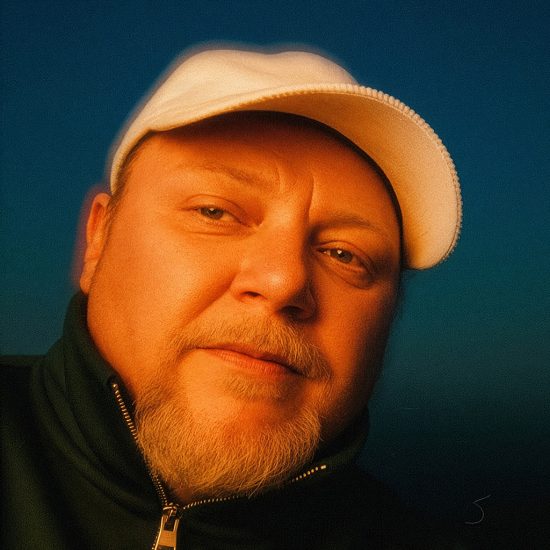
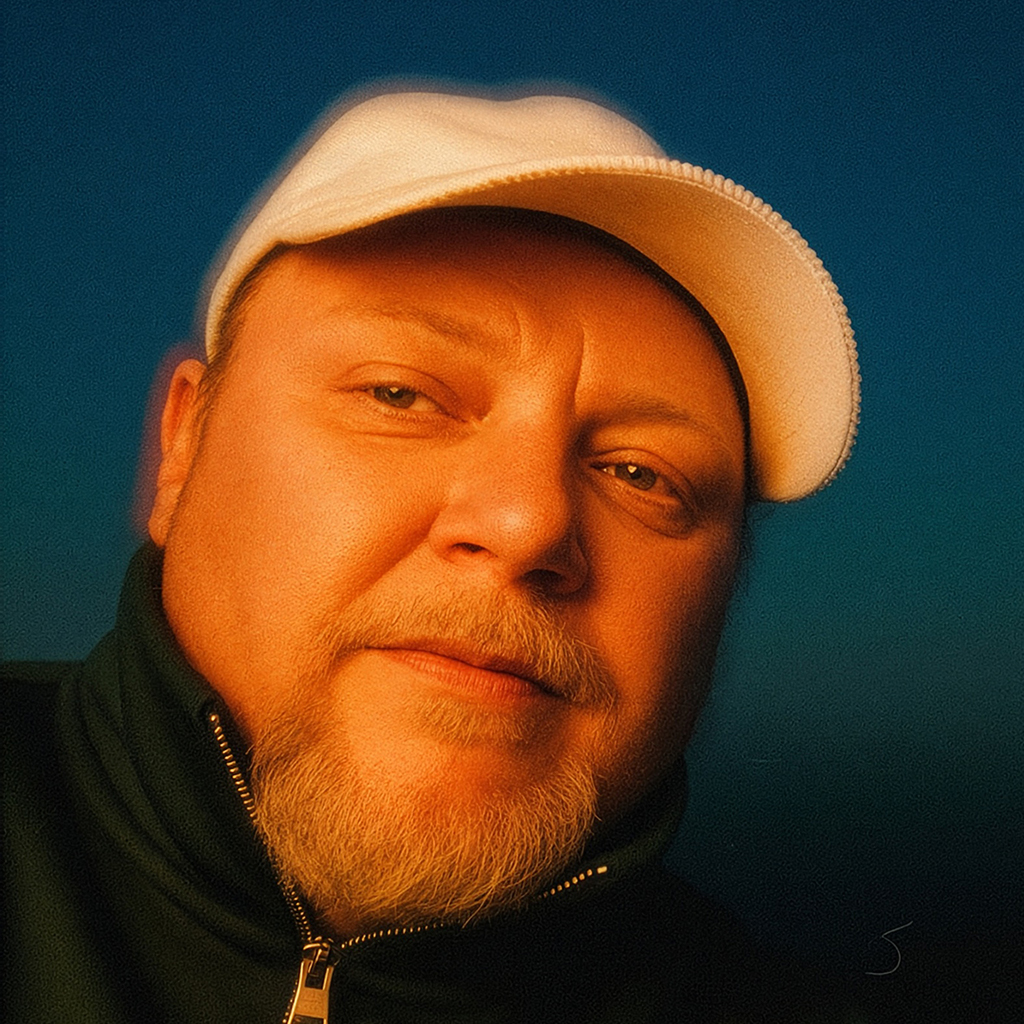
Damien Cain has realized a wide variety of projects in his more than 30-year musical past. He is back with his latest album “Standarte”. We talk to him about longing, melancholy, working with an idol, his life in Ireland and much more.
Drive, longing, melancholy
Orkus: Let’s start at the beginning. You started with music and your first band at an early age, didn’t you? What was the deciding factor back then that made you express yourself musically?
Damien Cain: It actually all started when I was 14, when I wrote my first poems inspired by Shakespeare in English class. Initially, I was interested in understanding and learning the technique of writing poetry, but I soon realized that I could express feelings and thoughts that I found easier to package poetically than to say directly to someone’s face. I was always driven by a certain longing and melancholy that has accompanied me throughout my life. Two years later, a school friend read one of my works and said, “That’s not a poem, that’s a song lyric!” – He played the piano, really well even then, composed music to the poem and we thought the result was so great that we decided to form a band. And Dirk, the piano player (later keyboardist), said that there was of course no one else who could interpret these lyrics properly apart from me, so I had to buy my first microphone. The first band, Celtic Crypt, was born and had its first public performance in 1988. Looking back, I would say that very early on we were doing something that was later called emo – paired with a gothic atmosphere.
Uncompromising
O: You have realized numerous interesting projects, including a musical and an Irish folk band. Then you were drawn towards gothic and metal with Cain, and now you’re back as Damien Cain with a fresh, open mix of styles. Was there a decisive event that “brought you back” in this direction?
DC: Hard rock has always been my thing, but I’ve always been open to musical genres of all kinds, from mainstream to experimental. And I think that’s what the new record reflects: this time it’s me at the helm of the music and I was able to translate my lyrics into the music I had in mind while writing. Don’t get me wrong, I’ve always enjoyed working on songs with my bandmates or composer friends and it brings a lot of creative input, but it’s always a compromise. – It was simply time for an uncompromising album.
Life, death, mourning
O: What is your personal connection to the dark scene?
DC: Dracula! When I was six years old and my parents weren’t at home, I watched the first Hammer movie with the great Christopher Lee late at night. I almost wet my pants with fear and couldn’t sleep for nights, but I was fascinated by the dark world, set somewhere in a Victorian-like country. This left its mark (obviously) – themes such as life, death, grief, loneliness and longing occupied me from then on and were my precursors into the darkness. Then there was the music: The Mission, Sisters, Fields of Nephilim gave me the feeling that my thoughts and feelings were being expressed here.
Working with an idol
O: You also wrote the song “Elenore”, which was sung by the incomparable Sir Christopher Lee. How did that “happen”?
DC: As I just mentioned, Christopher is definitely the hero of my childhood and youth. It was such an honor and one of the most extraordinary experiences of my life to work with this great artist. I was part of the “Edgar Allan Poe: Visions” project at the time, with actors and bands celebrating the author’s poems and stories ( Alexander Veljanov, Subway to Sally, FM Einheit and L’Âme Immortelle were also involved). We were able to persuade Christopher Lee to record the original English version of the poem “The Raven”. When we recorded with him in the legendary Townhouse Studios in London, we got chatting and found out about his love of opera and that he had already sung operas himself. Of course, there was only one question we could follow up with: “Would you sing for us too?” – He agreed immediately and together with the composers Simon Bertling and Christian Hagitte, we wrote “Elenore” for him and recorded the song with him a few months later. I re-released the song in the summer of 2025 to mark the tenth anniversary of his death.
Focus
O: Let’s focus on the new album “Standarte”. Why did this song become the album title and how did it come about?
DC: Standarte is a kind of continuation of what was probably the most important song of the Celtic Crypt era, “Wallenstein”. At that time a slightly provocative anti-war song, with a complex song structure in over 7 minutes playing time and for the first time with mixed language lyrics (German/English). The song was inspired by the painting “Christ of Saint John of the Cross” by Salvador Dali, another artist I greatly appreciate. Wallenstein as a warlord in the 30-year war was only the inspiration for the idea of the song, the name does not appear in the song. But he does now in “Standarte”. The world hasn’t gotten any better in the last 30 years. But my view of things has perhaps grown up a little. Stylistically, I have remained true to the bilingualism in the lyrics, and in terms of content it ties in with “Wallenstein” and also with Dali’s painting, in my interpretation “a neon cross is painted in the sky” as a sign of hope, or at least of the possibility of not resigning completely.
Colorful dark
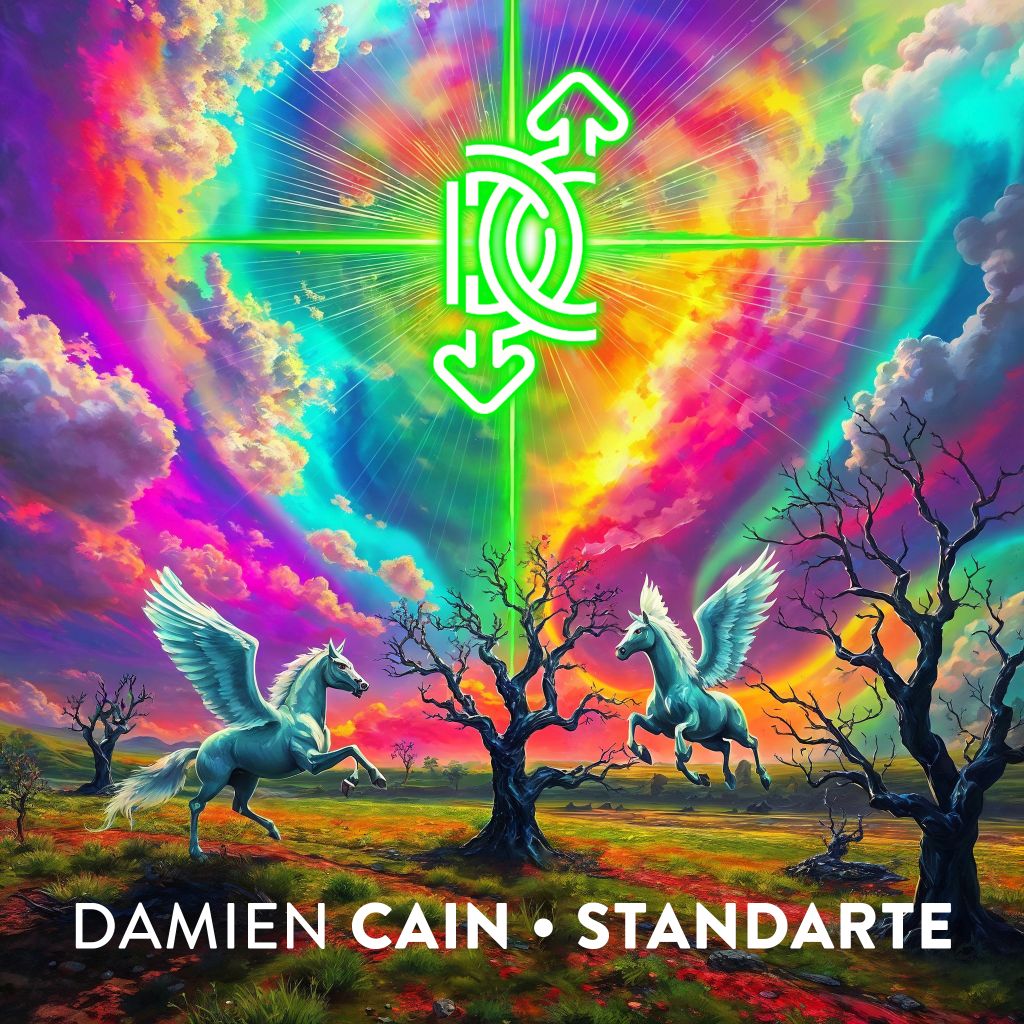
O: The album cover is particularly eye-catching. What was the source of inspiration for the two Pegasus, the gnarled tree and the sky shining in all the colors of the rainbow?
DC: Dali and surrealism are also the inspiration here. On the one hand, obviously the neon cross in the center in a barren area (an interpretation of the biblical land of Nod, where Cain was banished to), the Pegasus as a sign of creative freedom (which ultimately refers to the music on “Standarte”) and yes, the rainbow colors, because I want to show my colors even in the dark genre, which is probably more than clear in songs like “Caleb” or in the video for “Standarte”. Not particularly surprising for the people who know me, but perhaps not so ubiquitous in hard rock music.
In the next part, we talk about how Damien Cain gets things off his chest, useful tools and take a look into the future.
Claudia Zinn-Zinnenburg
Watch the video for “Standarte” here: