Interview with FALLING YOU (1/2)
Falling You was founded in 1995 in San Francisco by composer and producer John Michael Zorko. So of course a slightly belated congratulations are in order. For mastermind John Michael Zorko, the 30th anniversary carries little weight: “It’s interesting – I’ve never measured time like that in relation to the project. I think: “We’ve released eight albums” and look ahead to the next one. Human nature still offers a lot of fertile ground to explore!” – We talk about the new album “Metanoia” and much more.
changes – A summary
Orkus: How has working with music/writing songs changed for you over the course of these 30 years?
John Michael Zorko: It has changed in some significant ways. Of course, the technology and tools have improved tremendously. I still use mostly hardware – the same old Roland I’ve had for ages, the same old Virus (which I can’t imagine ever parting with), the same old DX7 and a few others – but software synthesizers have come a long way, and I use them sometimes.
Another big change for me was switching to long-distance collaboration. In the beginning it was just Jen (Jennifer McPeak – editor’s note) and I – two close friends, one of whom (she) was far more talented than the other (me). She would come over a couple times a week and we would work on music together. Today we live on different ends of the US, but we still communicate regularly and remain very close. Having her in my life – to whatever extent – has made me a better person, and although we have differences, we have always used them as opportunities to learn more about each other.
Even in the 2000s, the singers would usually come to me (or I would go to them) and we would record together. I really liked this 1:1 interaction, we listened to each other’s stories, became better friends, etc. These days, however, distance separates most of the people I get to work with. It’s rare that we can develop the music in the same room anymore. That’s okay, we are all individuals and life pulls and pushes us all in different directions. Our orbits change, but when they intersect, music still emerges. I’m always impressed by the magic they bring, even if it’s mostly from a distance these days.
Growth
O: “Metanoia” is about forced change. Did the theme slowly crystallize during the work or was it clear from the beginning?
JMZ: Initially, the idea was to reinterpret these myths from antiquity that have to do with change, but in a way that better fits the world we live in today. However, when the pandemic broke out and the whole world had to adapt in a very short space of time, I thought of so many people whose ideas/beliefs about the world (and themselves) were deeply shaken by these events. I realized that this was related to the original topic, but the aforementioned world we live in had changed in confusing and unsettling ways.
We all develop our own belief and value systems throughout our lives, but these beliefs can sometimes limit us rather than guide us. However, the outside world often does not match our beliefs. Rather, it tends to knock us down, throw us off course, plunge us into crisis, and this happens again and again. As much as we would like to believe that we are the result of our personal “growth”, the fact is that these external challenges often have a greater impact on the person we become by forcing us to confront beliefs that have not worked for us and have made these challenges much more painful than they would have been otherwise. We don’t just grow into the person we want to be, sometimes we have to change to become them. Hence the concept of metanoia – a change of mind/heart, often through adversity.
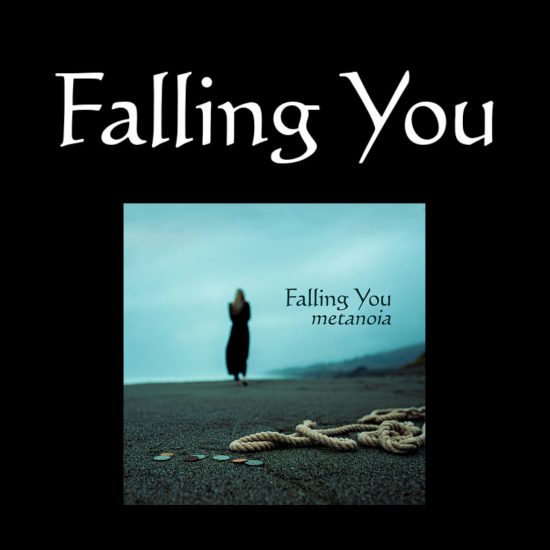
Hence the scene on the front and back of the album. The woman, who has freed herself from beliefs that have only made her life unhappy (religion and wealth as identity), throws them overboard and walks into an uncertain (but hopefully better) future in which she can create new ones.
Overexposed
O: I’m glad you brought that up. How did the album cover come about?
JMZ: I worked with the photographers to develop the album images. I had the general theme and content (the woman walking away, the discarded coins and crucifix, the severed rope), but they did a really good job of bringing out the mood I was looking for. It’s funny – they recommended a specific location for the photoshoot, and I remember being unsure if the location they chose would provide the atmosphere I wanted, but – as always – the creative people I have the privilege of working with are really on the same wavelength as me. They listened to the music, understood it immediately, and the venue they chose ended up being a perfect fit.
The model, Skylar, was a real trooper. It was a chilly morning, but she far exceeded my expectations by even going into the surf and letting the waves almost completely envelop her, which must have been freezing. Another example of how the talent of the people I get to work with both complements and eclipses my own.
The next part is particularly emotional.
Claudia Zinn-Zinnenburg
Listen to the new album “Metanoia” on Spotify: