Interview with HATEFUL CHAINS (1/2)

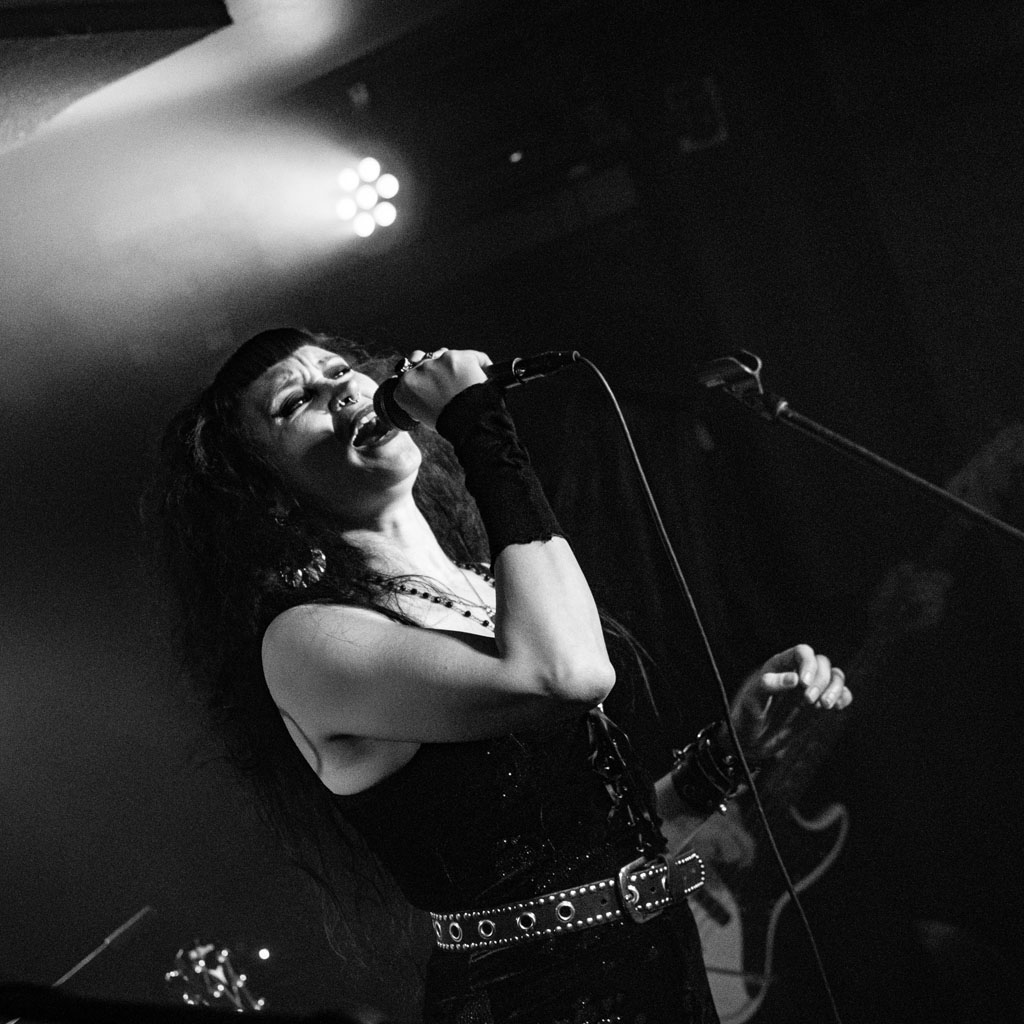
Before the Finnish goth rockers from Hateful Chains play at the annual Wave-Gotik-Treffen on May 23, 2026 at 20:00 in de Moritzbastei, we talk to singer Flora about her current album “Lambs and Goats”, ask critical questions of faith, ponder about the devil, life in Finland and the near future.
Orkus: In the last interview with Orkus! you mentioned that the lyrics of “Lambs and Goats” deal with the grieving process of letting go of the Christian faith and the anger that was also present during this process. How did you come up with these themes?
Flora Kok: When we started working on the second album, we had already accumulated a lot of material, because writing it down and turning it into songs was a way for me to process all the emotional processes that were going on during my faith crisis. The themes of anger and sadness seemed to crystallize naturally from these lyrics. Both are part of the process of letting go of something – perhaps they are the most obvious emotions. I don’t think I was really grieving the loss of faith at the time, but perhaps more the fact that something that had defined the course of my life turned out to be meaningless, and that there was just too much in the tenets of faith that I could no longer agree with. Disappointment, simply put, and the realization that I never had the faith in me to begin with. It’s all written down in the song “Burnout”. However, the anger came up when I came into contact with people from Christian sects and also read a lot about the experiences of people who had left these sects. The sheer injustice and abuse of power were terrifying and couldn’t really provoke anything other than anger.
O: What happened that made you turn away from the Christian faith you grew up with?
FK: Things happened in my personal life that made me question my upbringing and my faith. I felt like I wasn’t living up to the ideal. I was devastated because I kept trying but always failing, and because of the mental contortions I had maintained since childhood. I read the Bible to find answers, but it only raised more questions. I had read it several times before, of course, but had always brushed aside the obvious contradictions in it. But now I could no longer come to terms with the injustice it describes (for example towards women) and the way most sectarian Christians interpret it. There are of course some good things in it, like “love your neighbor”. But why do you need a god for that?
O: Have you found a new religion for yourself?
FK: I’m not religious at the moment. I could also call myself an atheist pagan. I’m endlessly curious about all kinds of mysteries and the occult and ancient ways of life and ancient religions, but I still have a strong aversion to anything that has to do with church or any kind of directed group behavior. Which is funny, because going to a rock concert is a bit like that. So, whatever I am, I’m a solo practitioner.
O: Do you believe in some kind of higher power? In a life after death?
FK: I haven’t yet clarified for myself what it actually means to believe in something. The honest answer to that for me is: I don’t know if there is life after death or a higher power, and I don’t know if I can ever really know. I also don’t think there is any proof of it. But if there were, I would have to admit that I am wrong. I can’t just dismiss other people’s experiences as completely invalid either. So these things could exist, but I don’t know, and I’m pretty bad at sensing or perceiving anything in particular. Maybe that will change one day.
O: How did you come up with the band name Hateful Chains?
FK: I came up with it by just brainstorming and writing down several suggestions for a band name. Hateful Chains just happened to fit the mouth well and can be interpreted in many ways, symbolically or whatever. Maybe it was something that came up from my subconscious. I didn’t initially connect it to the themes of the second album. I wouldn’t do that now either, but rather let it stand for all the chains that prevent you from living your life to the fullest. Most of them are in your head, I think.
O: The album gets off to a strong start with “Rotten Corpses”.
FK: Yeah, we’ve ended a show with that song sometimes, but it seemed like a strong opener for the album. It’s about the cult mentality that is cultivated by the leaders. Cults are hierarchical and based on a strong leader who can make you believe that only his truth is the real truth and that you can’t survive without belonging to his group. This applies to both religious and political leaders.
Claudia Zinn-Zinnenburg
We will continue our conversation shortly.
Line-up:
Flora Kok – vocals, keyboards, acoustic guitar
Kimmo Laaksonen – guitar
Jani Ilande – bass
Jani Vilhunen – drums
Watch the live video for “Lambs and Goats”:
Already subscribed to our newsletter?

Choose your favorite CD as a subscription bonus: