
ALLY THE FIDDLE: Burning locomotives, torn conductor’s pants, or welcome sausages in the train bathroom
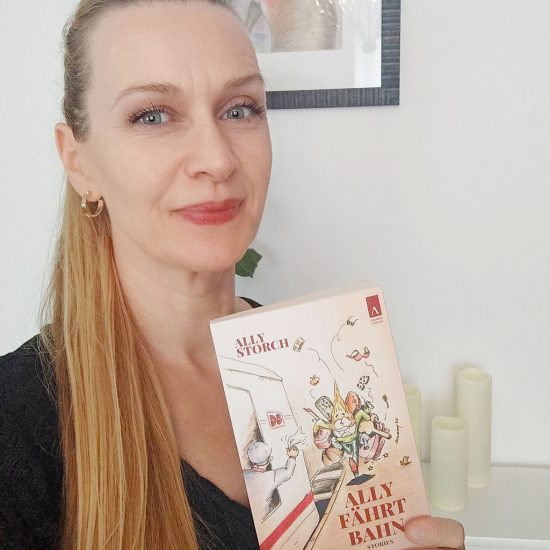
When Ally goes on a trip, she’s got stories to tell, you might say: Germany’s most famous rock violinist, Ally Storch, is always on the go. Thousands of kilometers a year. And when she’s not on the Subway To Sally tour bus, she’s usually traveling by train. Due to neglected infrastructure, heavy traffic, and outdated equipment, train cancellations, technical breakdowns, and delays are common. The stuff stories are made of. Ally Storch first documented them in regular online posts. And now in the book *Ally Fares by Train*, which will be officially available for purchase starting June 26. *Orkus!* editor Axel Heyder spoke with the musician.
Orkus: Anyone who uses the train can tell stories about it. What makes your stories special?
Ally: What’s definitely unusual is that I don’t just launch into a rant about the train. Instead, I tend to find amusing details or take a look at my fellow passengers. After all, there’s no need to even talk about the fact that so many things aren’t working right. So over the years, I’ve collected the things I’ve come across, and that’s allowed me to put together a colorful mix of burning locomotives, torn conductor’s pants, and welcome sausages in the train restroom.
Orkus: Dumb question: but do you like riding the train?
Ally: As absurd as it may sound, I actually enjoy riding the train. Over the decades, I’ve developed something of a “love-hate relationship” with it. The delays are annoying, and the shortcomings really get on your nerves—but the people behind the company usually go out of their way to help, and traveling by train is actually quite comfortable when you have a long journey ahead of you.
Orkus: What was the longest time it ever took you to travel a certain route because of a delay?
Ally: That’s hard to say. Once, I didn’t arrive until the next day because my train departed from a different station than the one listed, and the railway company covered the cost of my overnight stay. Another time, I left a day early because there was a major strike on the railway. What I’d find really interesting, though, is to know how many hours I’ve actually spent in my life leaving earlier than planned due to potential delays, and how many hours I’ve spent waiting for delayed trains. I wonder if it adds up to years by now?
Orkus: Do you remember the strangest reason you’ve ever heard for why your train was canceled today of all days?
Ally: Train cancellations don’t really get an excuse in the first place. Most of the time, it just says “Train canceled.” What’s really funny, though, is the “excuse roulette”—as I call it in my book—when it comes to train delays. There are all sorts of strange things on the tracks—burning bushes, delayed train preparation, and you name it. I think what made me laugh the hardest was the train engineer who couldn’t make it to his train on time because he was traveling on Deutsche Bahn.
Orkus: Do you already have a plan for how to react if the restrooms are locked again, the air conditioning breaks down, or your seat reservation is canceled?
Ally: Eye-rolling . For someone who travels a lot, that’s almost an everyday occurrence, and you just have to deal with it. Another thing that helps: always booking a Flex Ticket, because then I can switch to any train on my route.
Orkus: In my personal opinion, despite his million-bonus, Deutsche Bahn CEO Lutz had pretty much sidelined the company. Now Evelyn Palla is in charge and is making a difference. Do women do it better?
Ally: I would never generalize about something like that. My impression of the last CEO of the railway company was simply that he was interested solely in his own profits. Back then, he was determined to take the company public; they cut back on service, and ticket prices regularly went up drastically. That said, I’d rather leave the technical talk about corporate management to others, since I’ve already read quite a few books on the subject. I find the stories about what happens to customers much more interesting.
Orkus: If you were in her shoes, what would be the very first step you’d take?
Ally: I’d do it like other rail companies and combine the fare with a seat reservation. For those who really want to hop on at the last minute, you could then release a small number of extra tickets. At the same price. And bike cars instead of bike compartments. Those would then be reserved only for strollers, wheelchair users, and people with heavy luggage.
Orkus: How many times have you circled the Earth in kilometers on Deutsche Bahn—in other words, how many kilometers do you rack up each year?
Ally: I actually tried to estimate that roughly based on my receipts. Doing it more precisely, though, would have been as much work as filing a tax return. But one thing is certain: I easily reach the 40,075 km mark (Wikipedia)—and most likely several times over.
Orkus: Is the railroad better than its reputation, or even worse?
Ally: I think the railway is just like its image. You can see small efforts being made to improve service, and I’ve heard that the rail network and the condition of the trains are very difficult to fix. For passengers, however, the situation is still truly unacceptable at times.
Orkus: In other countries, there used to be a saying: “As punctual as the Deutsche Bahn.” Ever since the 2006 World Cup in Germany, at the very latest, the whole world has known that this is no longer true. What do you think has changed, and why can’t we manage it anymore?
Ally: I suspect that at the point when they should have gotten everything in order, they were more focused on their own profits. Now they’re just patching things up. As far as I know, the rail network is too small for such a complex transportation system. On top of that, long-distance trains often share the tracks with commuter trains, and even though these are frequently subsidiaries of Deutsche Bahn, the two seem to constantly get in each other’s way. And to me, as a customer, it feels as though the railway company actually gave up on the idea of being on time at some point. But as I said, I’ll gladly leave the analyses to others who are more knowledgeable on the subject. In my book, I’d rather talk about the oddities that result from this.
“Ally Takes the Train” is available in stores starting today—or directly from the publisher.
Already subscribed to our newsletter?
You can subscribe to the print edition of Orkus! magazine here:


