Interview with LIGHTSHIFTERS (1/2)
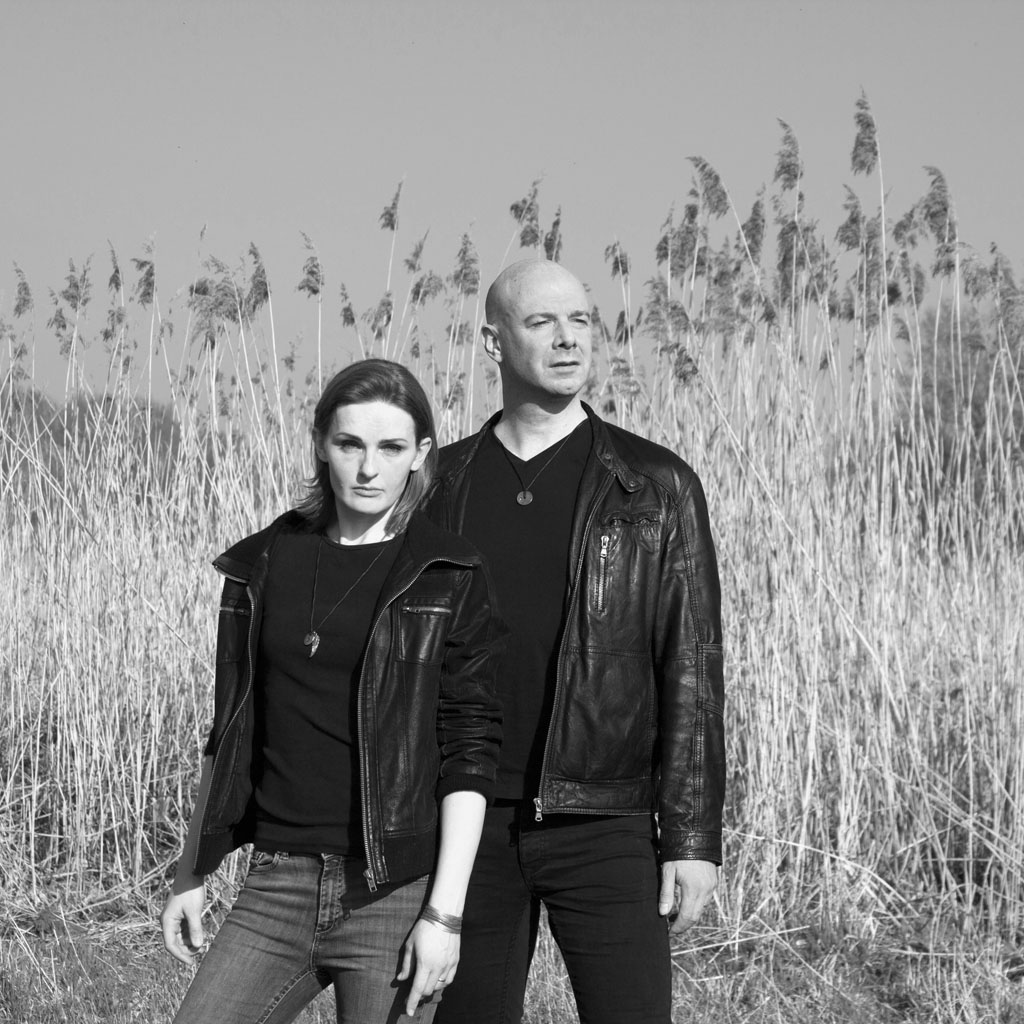
The Norwegian-German duo Lightshifters was founded in Lübeck in 2012. The pair have been living in Norway since the end of 2024 and have now released their EP “All Life’s Absurdities”, which sensually combines dark wave and synthpop elements. Read the first part of our interview here.
Orkus: Let’s start at the beginning. You’ve been working together since 2012. – Could that also be seen as the birth of Lightshifters?
Michael Pfirrmann: We got to know each other through our musician profiles on MySpace. We quickly came up with the idea of writing a song together, but then we also wrote to each other about all sorts of things for about six months. A very romantic story, because we had found our respective soul mates through this “letter writing”. My first visit to Norway was of course exciting, but after the first long hug at the airport, we got engaged straight away. A few months later, Marthe moved to Lübeck and we got married shortly afterwards. We then ran a studio together in Lübeck from 2012. Unfortunately, our Lightshifters project only ever ran on the side during this time. Due to the great popularity of our new EP, we now realize that we should have taken care of our own music much earlier.
O: How did you come up with the band name?
Marthe Borge-Lunde Pfirrmann: Our first song was called “Luminous”, which was already on the Orkus! compilation 83! I wrote it as a metaphor for a very distant unknown love in the universe that nevertheless feels very close and familiar. The name Lightshifters is inspired by this first song and a cosmological term: A light shift, usually referred to as a red shift, occurs when a luminous object moves away relative to the observer’s position due to the expansion of the universe, for example. The spectral lines of the light source are then shifted in the direction of the longer wavelengths. Our thought was that it should be possible for us as lightshifters to synchronize our wavelengths at any time with the help of music.
O: When and how did you first get in touch with Triphop?
Michael: The triphop influences probably come more from my side. I like the dark atmosphere and the groovy, organic elements in the music. Massive Attack are certainly among my all-time heroes. Although I wouldn’t say that we make triphop. You can just find elements inspired by triphop in one song or another.
Marthe: When I write music, I don’t think of a specific genre, but let myself be guided by feelings and inspired by sounds. I usually tend towards melancholic and mystical moods, so triphop is not too far away.
O: And with Dark Wave?
Michael: Well, like so many people, I grew up with Depeche Mode and The Cure in the eighties. Then came Ecki Stieg with his Grenzwellen, and in the early nineties I moved from the provinces to study in Hanover and the club nights in the alternative scene there. Martha’s first contact with dark wave is quite fascinating for us: in the early 2000s, she received a mixtape from a friend who was active in the Oslo gothic scene. It included a track from my band Inscape at the time that she particularly liked: “Verbrannte Welt” from our album “Neonsonne”. I had written the music for the song, which of course she didn’t know when we met about ten years later. Coincidence or fate, who knows? Everything is connected …
O: Let’s talk about the new EP. How did the title (or realization) come about: “All Life’s Absurdities”?
Michael: The title is a line from the song “Absurdities”. We came up with it at the very end, when all the tracks were finished. It sums up the very different songs on the EP quite well, which simply represent five absurd facets of life.
O: The first single release was this powerful track “Absurdities”. Is there a background story to it?
Marthe: Yes, they do exist. The song poses the question of whether life isn’t just a random series of events, which makes the idea of a meaningful life absurd. We have a few years of very negative events behind us. The most dramatic was when I went into hospital four years ago with life-threatening symptoms. It turned out that I have a rare predisposition and I can’t be sure that the symptoms in question will come back. So the song “Absurdities” has its origins in the experience of losing control over the course of one’s own life.
Claudia Zinn-Zinnenburg
Listen to “All Life’s Absurdities” on Spotify:
Already subscribed to our newsletter?

Choose your favorite CD as a subscription bonus: