
Interview with OCINN (1/2)

Ocinn was founded in 2007 and released her first album in 2020. We talk to Nico about her extraordinary project and the new album “Nebelgeister”.
Orkus: How did you come to make music in the first place?
Nico: To be honest, I can’t really name a specific moment. Music has simply always been a part of me. It accompanies my everyday life, makes me happy and lets me express my feelings. For me, music is like the air I breathe – I can’t imagine life without it.
O: You learned to play the piano at the age of five. Do you remember how it came about or how it became a real passion?
N: When I was little, my mom asked me if I would like to try out an instrument. At the age of five, of course, you don’t really know what options are available. She suggested that I could try the piano and I’ve stuck with it ever since. It was “my” instrument right from the start.
My passion for it developed very quickly, especially when I discovered classical music. Even as a child, I was incredibly fascinated by pieces by Mozart, Beethoven, Chopin and Schubert.
O: Do you play any other instruments and is there one that would interest you beyond that?
N: I mainly play bass, especially six-string. I am particularly fascinated by low tones and rather dark timbres. One instrument that has impressed me for a long time is the organ. This world of sound has interested me so much that I have recently started to study it intensively. At the moment, this is probably my most challenging project in a long time. Very complex, but also incredibly exciting. In addition to the bass, I also play a bit of guitar. But basically I’m open to any instrument and like to try out new things. I love getting to know different soundscapes and discovering new musical perspectives.
O: What’s the story behind the name? What does Ocinn mean?
N: Ocinn is a reflection of myself, my thoughts, my feelings and my inner world. This project reflects who I am as a person. That’s why I came up with the idea of using my own name, but portraying it as if in a mirror. That’s how Nico became “Ocinn”. A reflection of myself, the same person, just from a different perspective.
O: With “Nebelgeister” you are already releasing your fourth album. How can we imagine working on it? Did you have a certain concept in mind right from the start, a common thread?
N: When I start working, I like to let myself be driven by the creative process. I usually have a rough idea of the direction in which a piece might develop, but the actual central theme often only emerges during the work itself. With the “Nebelgeister” project, however, the theme was clear very early on, which gave the process a certain structure right from the start. My songwriting usually begins during the research phase. As soon as I discover something that touches or fascinates me, it becomes an inspiration and the creative process is set in motion. During this time, I worked intensively with classical music, minimalist piano music, but also with other art forms such as poetry and visual art. In between, there was even a phase in which jazz was an important source of inspiration for me. Even if this is not directly audible on the album, this period opened up new perspectives on my instrument. All these impressions flow into my work. Through research, I gather inspiration, so to speak, which feeds my creative process and from which the pieces gradually emerge.
O: What is the title “Nebelgeister” all about?
N: I have both German and Italian roots. With the album “Nebelgeister”, I deliberately wanted to focus on my German roots. The background to this is that I dedicated my previous trilogy “Songs from the Past” to my Ladin roots, a minority from northern Italy. The theme of fog was present from the very beginning. That’s why I have worked intensively on how fog is depicted and perceived in mythology, lyric poetry, poetry and also in the visual arts. I found inspiration in Hermann Hesse and Caspar David Friedrich, among others. In the course of this research, I finally came across the fog spirits. My own fog spirits take up stories and ideas from southern Germany, which I have revisited through my research and my personal interpretation. Fog generally has a very special atmosphere for me. Something dark and mysterious, but at the same time something romantic. The idea of foggy spirits reinforces and deepens this mood.
Claudia Zinn-Zinnenburg
We will be continuing our interview with Ocinn shortly. You can also find out more about her in our May/June issue.
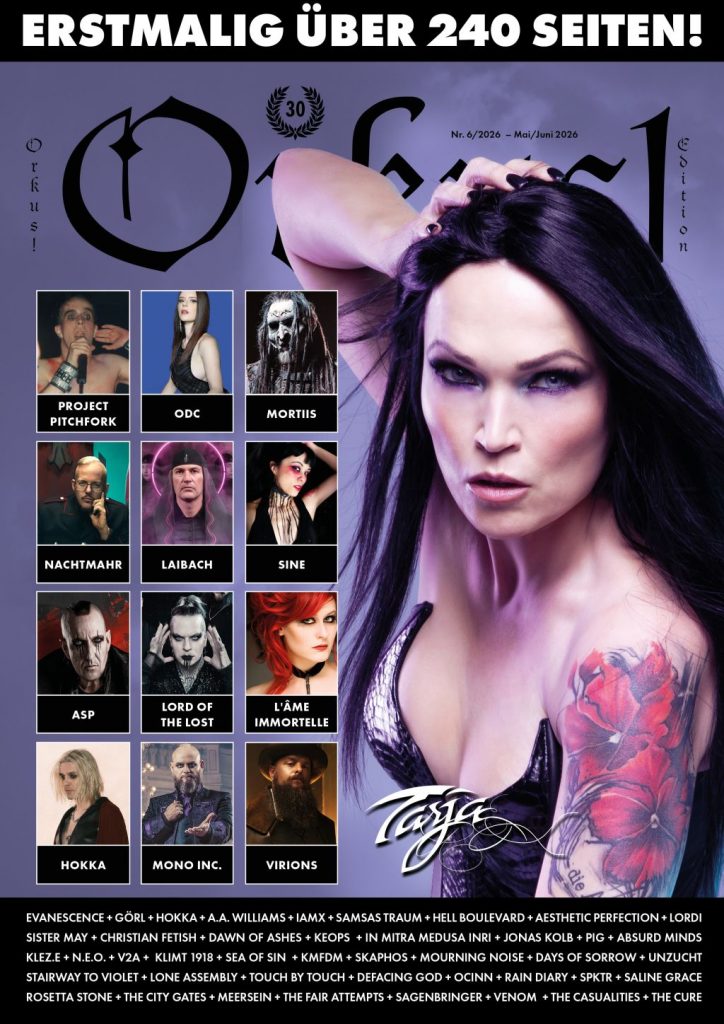
Order the May/June issue:
Listen to Ocinn in our “Current Issue” playlist on Spotify:
Already subscribed to our newsletter?
You can subscribe to the print edition of Orkus! magazine here:


