
Interview with BYRONIC SEX & EXILE (2/2)
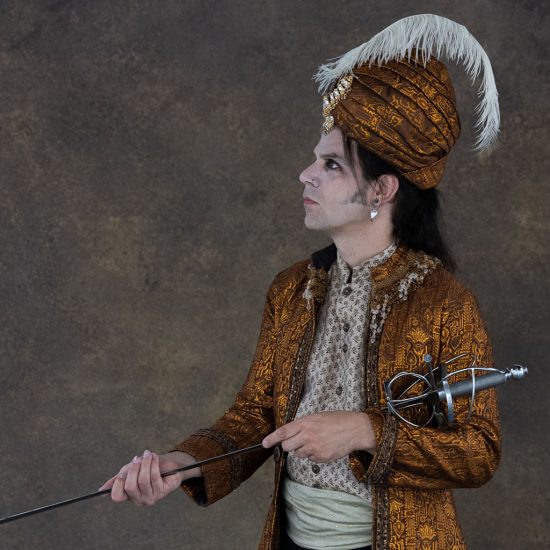
In *Byronic Sex & Exile*, Joel Heyes blends Gothic, Romanticism, and a healthy dose of rebellion. With his new EP, *Dauntless Zeal*, Heyes now strikes a decidedly more political note. Read the second part of our interview here. Did you miss the first part? No problem— you can read it here.
Orkus: The EP opens with a particularly dark version of “Bella Ciao.” When did you realize that this would be the perfect opener for the EP?
Joel Heyes: I had already recorded a much shorter version of the song on an earlier EP (“Lessons from the Mountain,” 2011) and had also played it live a few times during the “Unrepentant Thunder” tour. However, it had been suggested that we turn it into a longer, more complete version. So I really enjoyed expanding the track and letting it shine. As the opener, it seemed to me that it set the right tone while also signaling that there would be a significant stylistic shift on this EP.
O: The artwork is easy to associate with this song. What was your thinking behind choosing this cover?
JH: I had considered several different versions of the artwork. If you look at the BS&E covers so far, you’ll see that there aren’t many photographs of this kind. Ultimately, I felt that the famous photograph by Robert Capa, which shows a partisan in the Spanish Civil War, was perfectly suited to illustrate that this is something different and to convey the ideals of the material.
O: By doing that, you’re making it clear right from the start that this is a politically motivated EP. Why was it important to you to make this statement? How did the idea come about?
JH: I wanted to take a much clearer step in a more relevant direction. Since my projects up to that point had mainly focused on Gothic literature—the last album, for example, was a retelling of “Dracula”—I wanted to take a fresher approach that would still stay true to the project’s Byronic spirit. Political content has always been part of my repertoire—after all, I was the singer and songwriter for the industrial-punk band Action Directe—but with BS&E, I hadn’t had many opportunities to fully explore that aspect until now. I also wanted to give acoustic elements more space, especially those that would provide me with a pool of songs for solo performances. As for the actual statement: The political situation in the UK and around the world has become so bleak that songs about vampires simply no longer seemed appropriate.
O: “The Last Day of School” is also a bit gloomy. Is there a story behind it?
JH: “The Last Day of School” is specifically a protest song against the American bombing of the Shajareh-Tayyebeh Elementary School in Minab on the first day of the U.S.-Iran war in February of this year. The attacks killed 168 people, including 120 children. The school is said to have been on a list of targets allegedly provided to the U.S. military by AI technology companies. It was difficult to write this song because the result had to have a completely different energy—simply layering a message over a gothic rock track definitely doesn’t work here. Much of BS&E’s material in recent years had drifted from raw emotion to mere pathos. That’s why it was a challenge to approach this song with sincerity. At the same time, I had to be careful to treat both the subject matter and the people affected with the necessary respect, while still being clear enough to make an impact. I think I was able to bring at least a certain emotional depth and tenderness to it. The song is a bit more subdued than what usually fits my very aggressive style. For me, that was proof that a different kind of BS&E song can work, too.
O: The mood remains contemplative with your cover of Ewan MacColl’s “Jamie Foyers.” Why did you choose to reinterpret this song in particular?
JH: I love Dick Gaughan’s version and have always wanted to record my own take on a folk classic—another area BS&E hasn’t ventured into yet. I opted for something simple and dignified, featuring just acoustic guitar and organ, and wanted it to sound fresh and uncluttered. The subject matter—the death of a Scottish member of the International Brigades in battle—also fit perfectly with the atmosphere of the EP. So I was very happy with the result.
O: The EP ends with the thought-provoking “Give Raul a Gun.” Is there a story behind the song’s creation?
JH: “Give Raul A Gun” is another explicit protest song, this time about the ongoing U.S. fuel embargo against Cuba. The atmosphere is essentially one of serious resistance and a refusal to back down as the noose tightens further and further. Although it was also difficult to strike the right tone, the song was very straightforward to write. The lyrics came to me quickly, and I wanted to finish the track as soon as possible so that its emotional impact would be preserved.
O: Next year, you’ll be releasing your new album, “Last of the Goths.” What can you tell us about it at this point?
JH: “Last of the Goths”—the title comes from a poem by Southey—will be a continuation of my current idea to reconnect Gothic culture with its original political context: with the tradition of Romantic radicals like the Shelleys, Lewis, Beckford, Thelwall, and, of course, Byron himself. You can expect a combination of authentic cult Gothic rock and political medievalism. Make Goth Jacobin Again!
Claudia Zinn-Zinnenburg
Watch the video for “The Last Day of School”:
Schon unseren Newsletter abonniert?
Hier kannst Du das gedruckte Orkus!-Magazin abonnieren:


