An Interview with EPTA7 (Part 2 of 2)
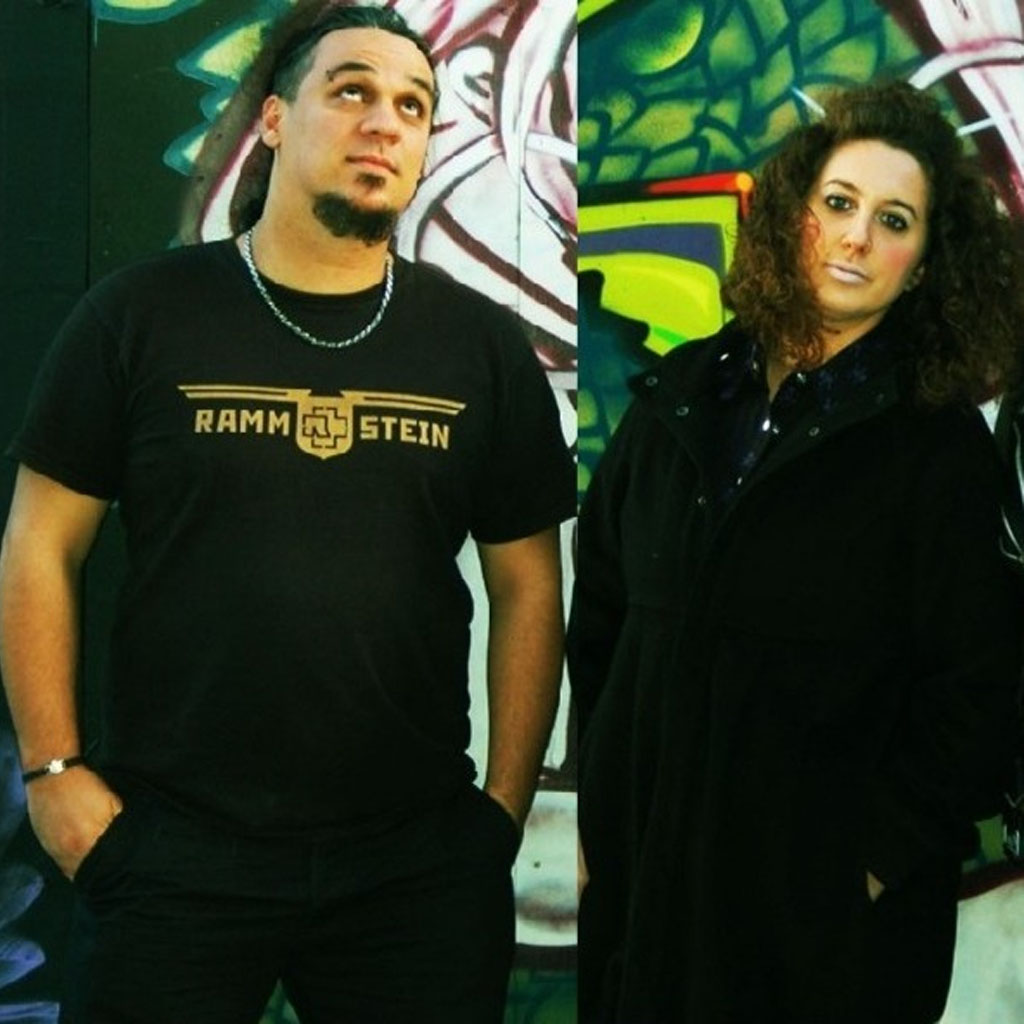
The Irish-Italian industrial metal project EPTA7 was founded in Dublin in 2012. We’re continuing our interview with the two founding members, Gianz and Miss Grey, about their new album, “Here Come the Freaks.” Did you miss the first part? No problem— you can read it here.
Orkus: “The Walls Breathe” gives me goosebumps just listening to it. How did this track come about?
Gianz: There’s actually a very personal story behind this song that goes all the way back to my childhood, when I was about six or seven years old. I think every kid has some kind of strange little obsession. One of mine always surfaced whenever I visited my grandparents’ homes. They lived in old houses that had previously belonged to other people, and I was fascinated by the idea of all the generations who had lived there. People had been born there, grown old, and probably died there, too. I wondered if perhaps something of them had been left behind. I had the strange habit of lying flat on my back on the floor and staring at the ceiling. From this completely different perspective, after staring for a long time, I could almost convince myself that the walls were moving slightly—expanding and contracting, as if the house itself were breathing. And when I was alone in those houses, that feeling grew even stronger. The old furniture, ornaments, lamps, and objects around me seemed almost alive. Some of them had been there much longer than I had. I remember thinking: “If this lamp has been standing here for a hundred years, imagine everything it has seen.” That idea stayed with me as I grew older and eventually evolved into something bigger: the notion that places and objects somehow absorb the emotions of the people around them. Imagine a three-hundred-year-old house where generations have been born, loved, suffered, and died. What if the walls could preserve something of all those lives? So the walls in the song aren’t just haunted by ghosts. You remember. The house has absorbed so much human experience that it has almost become a living organism in its own right.
O: First, an image or a scene from a movie comes to mind, and then the music takes shape. How can we picture that?
EPTA7: Yes, absolutely. For us, it usually starts with an image, a scene, or even just a feeling. We see the world first and then try to find its sound. That doesn’t necessarily mean we compose everything from scratch afterward. Sometimes we already have a bassline, a chorus, a few verses, or a musical idea that came about independently. It’s almost as if fragments that originated independently eventually recognize each other and become part of the same story.
O: Which scene from “Here Come the Freaks” has stuck with you the most?
EPTA7: When we close our eyes and think of “Here Come the Freaks,” the image that sticks most strongly in our minds is definitely not a comforting one. We see the procession of freaks: outsiders, the marginalized, people who are viewed as strange or different, marching forward together while the so-called “normal” people watch them in fear. They seem to be the monsters. But they’re not. History has shown us time and again how dangerous it becomes when a society decides that a certain group is somehow different, abnormal, or threatening.
O: In “Walking Ghost,” we’re confronted with the realization, “You will die!” Is there a story behind the song?
EPTA7: Yes, although “Walking Ghost” is one of those songs whose meaning has never been fully defined—not even for us. And maybe that’s fitting, because it was actually the very first song ever written for EPTA7.One possible interpretation of “Walking Ghost” is that of an outsider who has become nearly invisible to society. You could imagine a homeless person walking down a busy street while hundreds of people pass him by without really noticing him. Or perhaps he’s one of those strange street prophets carrying a sign announcing the end of the world. Everyone thinks he’s crazy, but maybe he’s just saying something no one wants to hear. Because “You will die!” isn’t really a threat. It’s a Memento mori.
O: How did the track “Kartoffeln” come about?
Gianz: This song has a much less philosophical origin—and since I’m telling this story to a German magazine, I suspect you’ll really appreciate it! (laughs) Our first self-produced EPTA7 demo contained four tracks: “Walking Ghost,” “EPTAsystem,” “Moon Canvas,” and “Fallen Gabriel.” After the release, we immediately continued writing new songs, and “Kartoffeln” was the next song we worked on. We already had a guitar riff, and when we played it in the rehearsal room, we all agreed that it had a certain Rammstein vibe. Rammstein has always been a huge influence on me—not just musically, but visually as well. Few bands have managed to blend music, visual language, performance, and identity into such a complete whole. One day, we were working on this very German-sounding riff in the rehearsal room, and I was eating fries. Miss Grey took in the whole situation—the Rammstein-esque riff and me sitting there eating fries—and came up with the obvious solution: “Let’s call it ‘Potatoes’!” There was just one small problem that you Germans will, of course, spot right away: “Kartoffeln” doesn’t mean “fries”! (laughs) It was actually supposed to be just a temporary working title. But we kept developing the song, nobody could come up with a better title, and at some point “Kartoffeln” just became the official name. The song itself, however, is much darker than its title suggests. It’s about a killer who roams the city looking for victims. But he’s not just a bad person. He, too, is a freak—someone who has been corrupted and transformed by the city. He wears a human mask to hide what he has become, and behind it, he commits terrible crimes. Yet while he hunts other people, he, too, is being hunted by something. Gradually, he realizes that someone is following him, and the hunter begins to feel the same fear as his victims. Eventually, we discover that what is pursuing him is EPTA7 itself—the entity at the center of our world.
O: What are the Irish and Italian industrial rock scenes like?
Gianz: That’s an interesting question, because in my experience, neither Ireland nor Italy has ever had a massive, clearly defined industrial rock scene, the kind you might associate with countries like Germany. In both countries, industrial tends to exist somewhere between other scenes—metal, goth, electronic music, alternative—and perhaps that’s one of the reasons why EPTA7 has developed the way we have. We never really felt like we had to follow the rules of a particular scene. Italy, of course, has an enormous music culture. When I played there, however, industrial rock was still relatively underground compared to more traditional metal and rock. There’s also something very Italian about drama, visual expressiveness, and strong emotions, and I think some of that inevitably found its way into our music. Ireland felt different. The scene was smaller, but Dublin in particular was very multicultural. You could meet musicians with completely different backgrounds and influences, and there was a certain freedom in that. When you’re operating outside the mainstream of a genre anyway, you worry less about whether something is “industrial enough,” “metal enough,” or “electronic enough.” You just use whatever works. And maybe it even helped us to be outsiders in a clearly defined industrial scene. EPTA7 ultimately incorporated elements from industrial rock, metal, electronic music, post-punk, and film scores, without ever feeling completely at home anywhere. Of course, in an interview with a German magazine, we have to admit that you guys have a slight unfair advantage when it comes to industrial music! (laughs) But maybe that’s exactly why an Irish-Italian take on it might sound a little different.
Claudia Zinn-Zinnenburg
Lineup:
Miss Grey – bass, backing vocals
Gianz Vukodlak – drums, percussion, sampler, backing vocals
Check out the lyric video for “Fallen Gabriel”:
Already subscribed to our newsletter?

Choose your favorite CD as a subscription bonus: