Interview with AUGER (1/2)
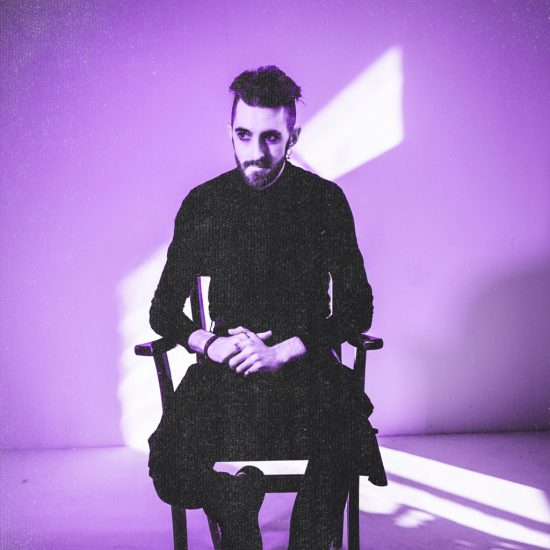
Auger was founded in 2017 by Kyle Blaqk in Blackpool, UK. Kyle now lives in Germany, in Fürstenwalde to be precise. In our two-part interview, we talk to the likeable Brit not only about the reason for choosing his new home, but of course about his new album “The Old Arcade” and learn that sometimes the best things happen by chance.
Orkus: What was the decisive moment that made you decide to become a musician yourself?
Kyle Blaqk: I don’t think there was a specific moment, but rather a lifelong curiosity that led me to the realization early on that music makes me happy! Growing up, my mom was a singer and my dad was a music producer, so music was omnipresent not only in my childhood, but in my siblings’ as well. My older brothers are responsible for all the noise I make today (also known as “music”). Since it was the guitars they bought and the issue of “Music 2000” that they showed little interest in that I then experimented with. And so it began. It was music video games when I was seven years old and learning to play guitar that set me on the path I’m on today.
O: How did you get the idea to found Auger?
KB: To be honest, Auger was more of a coincidence. It came about when my friend and I got tired of tinkering with a mix for a band we were playing in at the time. In hindsight, we had zero knowledge of mixing or studio work, so it was inevitable that we’d get stuck at some point. So, in a fit of supreme procrastination, we set about plugging in the guitars and recording something of our own. And after a brief goth music orgy on YouTube, we created a tribute to BlutEngel in our first song “New Life”. I sent that to my stepdad, as he was a fan of that kind of music, and he said, “This is really great, do you have any more?” We didn’t, but we enjoyed the process so much that we went for it – challenge accepted. The first week we had six songs already, Stephen asked, “I’ve booked a live gig for you, what’s your band name?” We looked at each other as if to say: wait a minute … this is a band now? Like I said, a total coincidence, but the best things always are.
O: How did you come up with the band name Auger?
KB: Well, like I said, we didn’t even know we were in a band, and we had a gig in just a couple of weeks… so we had to think fast! The first songs we wrote followed a fictional narrative about a monster that lived deep in the mines, and since mining was industrial, we felt that fit the mood of the music we were creating. And at this point I’d like to say that we thought long and hard about the name, but in truth, after a quick Google search for “mining terms from A to Z” and an even quicker scroll down the page, we very quickly found “Auger”, just after “Anvil”. It sounded powerful, a bit German… “That fits”, we agreed! A note for anyone interested: it’s pronounced in English like “Or-gur” and in German like the “Or” in “Ort” with a hard G at the end, as in “genau” and “geil” … and what started out as a helpful guide has, I fear, now opened the floodgates so that everyone is now chanting “Ort-genau” when they demand an encore.
O: Haha! What made you decide to move from England to Germany?
KB: Moving to Germany has been a dream of mine for ages, and since 2021 I’ve been actively trying to make that dream a reality. Due to a number of circumstances, including the B word… Brexit (sorry, I don’t mean to swear), the move was quite difficult. Nevertheless, during this time I put everything I had into Auger to move the band forward and hopefully get into a position where I could not only relocate, but where the move would help the growth and progression of the music. And by the summer of 2024, everything had fallen into place for it to work out. As for “what made me do it”, well, the list is pretty long. But as you’d expect, with any big decision like moving to another country, you have to consider a variety of factors. Just to be clear: I love it here. I think it’s beautiful, people can drive here, it’s clean… and then there’s spritzkuchen, bratwurst, the weather and the highways.
O: What do you miss about your old home town of Blackpool?
KB: Having lived there for so long, I am overcome with an overwhelming sense of familiarity when I return. But when I walk through the streets, I’m still torn. On the one hand, this familiar feeling: I know where everything is, I feel a bit of nostalgia and I know that my family is nearby. On the other hand, I can’t help feeling that it could be so much better. It could be free of litter, the buildings could be looked after and not neglected, and the weather could certainly be better! But that also stems from my love of Blackpool and England in general. It’s a country that has so much to offer, and there are countless wonderful things about it – especially in Blackpool. I can only urge everyone to go there! It’s just that I can’t help but imagine what it would be like if it was a city in Germany, or Finland, or Denmark, where there is a much stronger sense of civic pride and much more freedom. Of course, a quicker answer would have been: I miss my family. Which I do, a lot. But I love to really let off steam, so I couldn’t resist.
O: What do you particularly like about Fürstenwalde?
KB: It’s Brandenburg’s best-kept secret! What I particularly love is that it’s just the perfect size. It’s a relatively small city. You can walk from the train station in the far north to the south in less than an hour. But it’s big enough that it feels lively, there are normal stores and lots to do – and there’s also a lot going on in the city. It’s only 30 minutes to Berlin by train (when the RE1 is running) and 25 minutes to the airport by car. The people are friendly, there’s lots of great history and plenty of great restaurants.
O: How and through what did you first become aware of “the darker side of music”, and how old were you at the time?
KB: I grew up with this music. From the age of six, while my friends were into Girls Aloud and Sugarbabes, I liked Ozzy Osbourne, Gary Numan and Mesh. My mother was the singer in a goth band called Faithful Dawn in the nineties, so our music collection was rich with bands like The Sisters of Mercy and The Mission. Because I was curious, I took CDs and played them in my room. I just thought it was so cool and wanted nothing more than to wear a black cowboy hat, have long hair and basically be Wayne Hussey.
O: In a scene that is getting a bit long in the tooth, a breath of fresh air is certainly good. But judging by the lyrics, that doesn’t mean a lack of life experience. Where do you find your inspiration?
KB: It’s true that most of the bands on a festival line-up were making music before I was even born… and as long as I can still get away with making people feel old before the tide turns, I fully intend to do the same. I’ve always been inspired by songwriters who use their songs to tell stories. People like Fish from Marillion and Suzanne Vega are masters at it. I see it as a challenge to fit a whole story or the complexity of emotions into just a few lines of a song that is only a few minutes long. So in some cases where I don’t have the specific life experiences, I try to put myself in the shoes of a character who might have them and tell a story from their perspective.
Claudia Zinn-Zinnenburg
We will continue our interview shortly.
Watch the video for “The Old Arcade”:
Already subscribed to our newsletter?

Choose your favorite CD as a subscription bonus: